
Article F.3B – Why a clothespin placed higher “improves” the balancer
(by Pietro Olla – Teacher, Educator, Trainer and Educational Clown)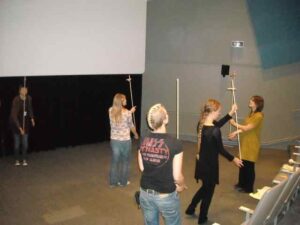
🎩 From the phenomenon to the scientific question
We left the laboratory at the most beautiful point:
the learning walk.
People took sides, formulated their hypotheses,
tested with their own hands what unstable equilibrium feels like,
and discovered — often with genuine surprise —
that the stick is easier to balance with the clothespin higher
than with the clothespin lower.
Now comes the question that truly ignites science:
👉 Why?
What is happening in our bodies and in the stick?
In my workshops, this part always comes after the experience.
Because the body must speak first.
🔍 The observed fact: the fall slows down
When the clothespin is placed higher, the stick:
- falls more slowly,
- gives more time to react,
- allows more effective micro-corrections,
- feels “kinder” to the person holding it.
Everyone feels it — even before knowing why.
The evidence is bodily, perceptual, undeniable.
But the reason… is far from intuitive.
🧠 The physical key: moment of inertia (no formulas, for now)
To understand what is happening, we need to introduce a fundamental concept
from rotational mechanics:
👉 moment of inertia.
It is a physical quantity that describes
how much an object resists changes in its rotational motion.
In very simple terms:
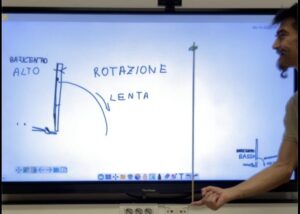
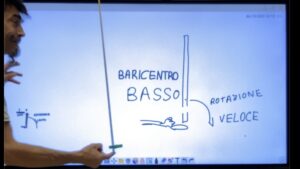
- if mass is concentrated close to the pivot point → the object falls faster;
- if mass is distributed farther away → the object falls more slowly.
Placing the clothespin higher moves part of the mass farther from the point of support,
thus increasing the moment of inertia.
The result?
👉 The fall slows down.
It becomes more readable, and we can control it better.
It does not improve equilibrium in an absolute sense.
It improves the balancer, by giving them more time to react.
🧘♂️ Slowness as an ally of learning
This is the most powerful educational aspect:
the body understands before the mind.
When the fall slows down:
- the system becomes less chaotic,
- the movement is easier to interpret,
- feedback becomes clearer,
- the gesture resonates with our ability to anticipate.
This is a perfect example of embodied learning:
intuition emerges from action,
not from formulas.
🌈 A reflection on how we learn (without judgment)
During my workshops, a curious scene often unfolds:
some participants change sides
only after they have understood.
Others trust their bodies immediately
and move even without fully understanding.
This is not about being “right” or “wrong”.
It reflects a cultural difference:
- some people adopt a more theoretical approach;
- others rely more on bodily experience.
In my workshops, these two modes emerge very clearly.
It is not a rigid division between men and women.
It is a tendency I observe frequently,
linked to individual histories and educational backgrounds.
Some people (more often men with a scientific background)
tend to rely on theoretical ideas before surrendering to experience.
Others (very often women, even with scientific training)
place greater trust in the body as an immediate source of knowledge.
This is not a rule.
It is not a judgment.
It is a recurring phenomenon that tells us something important
about our relationship with knowledge:
👉 the body knows before the mind —
but not everyone is used to listening to it.
🌬️ The final educational metaphor
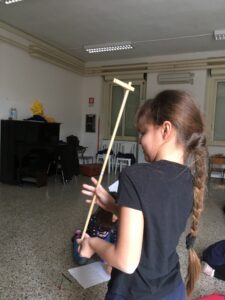
Balancing the stick is not about standing still.
It is about continuous correction.
It is an equilibrium that lives in time,
that accepts falling as part of the game,
that is built by listening to variation rather than stability.
The clothespin placed higher does not make the object stable.
It makes us more capable of dancing with its instability.
And for education, this is a powerful metaphor:
👉 We should not look for perfect balance.
We should look for the rhythm of corrections.