Article F.2 – The Raft and the Balance
The body in search of its center
(by Pietro Olla – Teacher, Educator, Trainer and Didactic Clown)
🧭 Opening scene
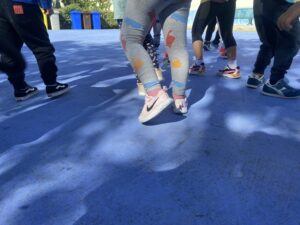
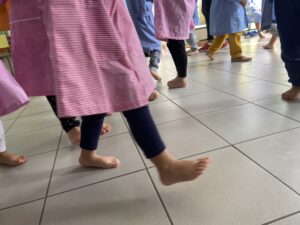
A long, imaginary, rectangular raft made of blue adhesive tape crosses the gym floor.
Students step onto it one by one, then in groups, then they move, gather, and separate, under the careful guidance of the clown-teacher, who alternates playful and social instructions, jokes and comic stumbles, with scientific information that is necessary for understanding and useful later for the processing of knowledge.
Each configuration changes the balance of the raft, which sways in search of a new equilibrium.
No one speaks: everyone observes, listens, adapts.
The facilitator, through maieutic questions, guides the group to bring out words such as balance, distribution, geometric center and center of mass.
Without stopping for too long, the participants spread out along the raft, but it does not always remain horizontal. Imagination helps, but the sensation of standing on a raft is real, and so is the search for balance. Yet there are distributions that do not allow the raft to remain in balance.
Like this one.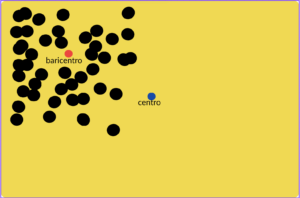
“Everyone freeze! Is the raft in balance now?”
“NOOOOOOO!!!!!”
If the raft is not in balance, the center and the center of mass do NOT coincide.
If, after this chorus of enthusiastic shouting, no one enters the room (… KNOCK KNOCK, oh… excuse me professor, I thought they were alone… or even worse KNOCK KNOCK, sorry Pietro, my students also have the right to study in silence, they even have a test next week…), then it is possible to start walking again in search of a distribution that allows the raft to remain in balance…
GO!
Then they start again and together, the girls and boys walk, and by walking they search for the physical balance of a non-existent object that is, however, absolutely real in our brains as they learn about equilibrium.
Some formulate the golden rule, the syllogism:
“If the center and the center of mass coincide, the raft is in balance.”
The sentence is repeated, even in negative form, until the play of words intertwines with the play of bodies and movement becomes the most direct way to “feel” the center of mass.
It is an unconscious choreography, made of bodies and weight, of geometry and relationships.
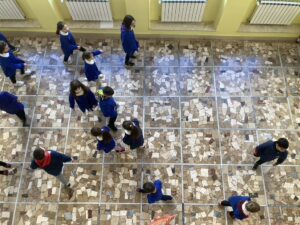
📸 (Photo of the distributions on the raft, seen from above.)
🎓 Educational message
Every physical system can reach conditions of static or dynamic equilibrium when forces and mass distribution are balanced.
In this workshop, the raft becomes a living—though imaginary—didactic tool: it makes the concept of the center of mass and its transformations visible.
By experimenting with different spatial distributions:
uniform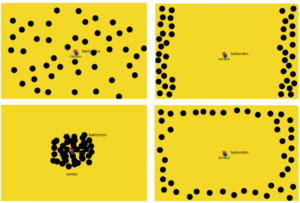
symmetric bipolar
central
symmetric peripheral
girls and boys discover that balance does not depend only on “how many we are,” but on how we are arranged.
The body becomes a measuring instrument, and the shared space turns into a lesson in classical mechanics.
📐 Educational perspective: from an a-didactic situation to formalization
The activity arises from an a-didactic approach, as described by Guy Brousseau.
There is no introduction to the game. No initial explanation, no definition.
Only experience, observation, comparison.
Only at the end does formalization emerge:
• The center of mass is the point where weight forces are concentrated.
• The balance of the raft is maintained when the center of mass remains close to the center.
• Symmetrical configurations enhance stability.
In this sense, physical experience prepares the way for theory, and not the other way around.
📚 Theoretical references
Guy Brousseau (1998). Theory of Didactical Situations in Mathematics – A-didactical situation.
G. Anzellotti, C. Giacobazzi (2001). Physics! Lessons and experiments in school – chapter: equilibrium of extended bodies.
🔬 Scientific in-depth – Formalization
1. Center of mass of the system
The center of mass of a group of bodies is calculated as:
R_cm = ( Σ mᵢ · rᵢ ) / ( Σ mᵢ )
“R is the position vector of the center of mass.”
This means that it:
• remains single and point-like,
• but changes position according to the distribution of weights,
• the center of mass tends to shift together with the movement of people along the raft.
When everyone stands at the edges, many children fall into a cognitive trap:
“The center of mass is where there are more people, so at the edges…”
But that is not correct. Remember the syllogism?
If the raft is in balance… the center and the center of mass coincide.
2. Condition of equilibrium
A system is in static equilibrium when:
ΣF = 0
Στ = 0 (sum of torques)
In other words:
• weight forces must balance,
• torques must not generate rotation.
On the raft:
• central distribution → balance – horizontal raft
• uniform distribution → balance – horizontal raft
• symmetric peripheral distribution → balance – horizontal raft
• symmetric bipolar distribution → balance – horizontal raft
Golden rule:
Stable equilibrium ↔ center of mass inside the base of support
Unstable equilibrium ↔ center of mass close to the edges of the base or outside it
In life, as in physics,
what matters is not only how many we are,
but also how we are arranged.