
Article F.3A – The Balance that Wavers
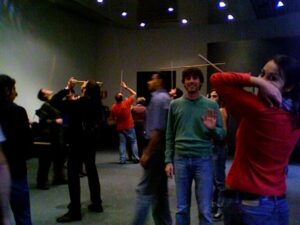
The Stick, the Finger, and the Silent Dance of the Body
(by Pietro Olla – Teacher, Educator, Trainer and Didactic Clown)
Scene of the Workshop
A raised finger.
Above it, a long wooden stick.
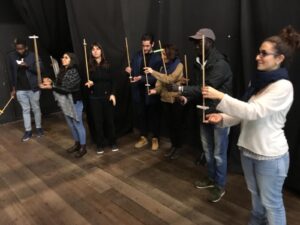
The bodies of the participants—adults, children, teachers—hold their breath as they try to keep it upright.
Some smile.
Others tremble.
Still others follow the stick with small steps, searching for a balance that always seems to elude them.
Balance, here, is not a concept: it is an experience.
It is a silent dance between the body and the object.Educational Premise: Center and Center of Gravity, Two Ways of Knowing
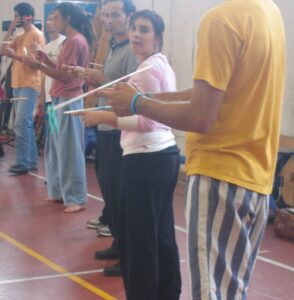
After the usual warm-up, both physical and emotional, I offer each participant a thin wooden stick, about 70 centimeters long.
I ask:
👉 “With one hand, hold the stick.
With the other… point to its center.”
And it always happens the same way:
Some look at the ends and point to the equidistant point,Others place it on a finger and find the center of gravity.

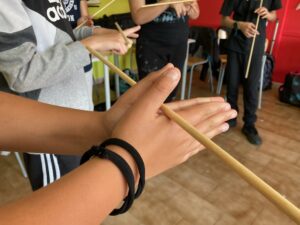
I stop them.
I have them observe.
“Do you see?
Some of you have found the geometric center.
Others, instead, have found the center of gravity.”
These are two simple actions. Both are correct.
But they represent two distinct approaches, two epistemic modes, two ways of building knowledge:
one intellectual, measurable, mathematical;one bodily, experiential, sensitive.
🟢
The First Twist: The Clothespin Breaks the Symmetry
I pull out a single clothespin. I clip it to my stick. I don’t say anything.
I lift it, balance it on a finger… and ask:
👉 “Now, is the center of gravity still in the center? Can we still say the weights are distributed evenly?”
The group answers in unison: “No!”
The clothespin has changed the object.
The geometric center remains the same.
But the center of gravity… no.
It’s the perfect moment to ask the sharp question.
❓
The Sharp Question that Sparks the Scientific Method
I show the stick vertically with the clothespin attached.
Then I ask:
👉 “Do you think it’s easier to keep it balanced vertically with the clothespin on top or at the bottom?”
This is the beginning of the Galilean method. The question invites observation.
And here’s the scene I love the most:
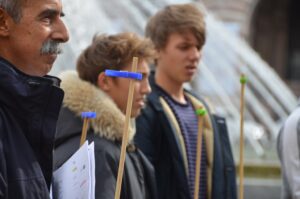
The audience lines up at my invitation. Everyone formulates their hypothesis and takes a position. Physically.
On the left, those who say: “easier with the center of gravity low”
On the right, those who say: “easier with the center of gravity high”
No explanations. No formulas. No clues.
Just a choice. The hypothesis.
🚶♀️🚶♂️
The Walk of Learning
At that point, I smile and say:
👉 “If you’ve understood the spirit of Circosciences… you already know what we’re doing next.
I won’t give you the theory. I won’t give you the formula. I won’t explain. I’ll give you… the clothespin.”
That is, the direct experience.
I hand out a clothespin to each participant.
Now, everyone has two possibilities:
Clothespin at the top
Clothespin at the bottom
And the real experiment begins. The game.
The body comes into play.
And one by one… people either switch sides or confirm their hypothesis.
It’s the walk of learning:
the physical movement that tells what the mind hadn’t predicted.
🔍
Embodied Epistemology: When the Body Contradicts the Theory
During workshops with teachers and science communicators, I always point out an interesting detail:
👉 The last person to move is almost always a man with a high level of scientific training.
In my experience, the male engineer is the one who most struggles to accept what’s happening:
that the body responds “A,” while the head had answered “B.”
Learning without understanding—even for just a few seconds—is, for many men, an epistemological heresy.
Women, on the other hand, in general, move earlier, even if they are engineers.
Not because they “guess,” but because they trust the bodily experience as a source of knowledge more and are generally more open to accepting reality without understanding everything.
They embrace the perceptual data before demanding an explanation.
In the little game of the stick, we see a larger cultural dynamic:
the different relationship between masculinity and femininity with knowledge, the body, doubt, and control.
As educators, we cannot ignore it.
And I say this as a man, male, engineer.
Not as a neutral observer.
✨
Educational Metaphor
The stick does not fall because we make a mistake.
It falls because it is unstable.
And maintaining balance does not mean “standing still”:
it means continuously correcting, listening, anticipating, breathing.
It is a balance that lives over time, not in space.
A perfect metaphor for education:
not asking for stability,
but accompanying the micro-oscillations.