
F1. The Ball That Rises and Falls

Discovering Gravity Through Juggling
by Pietro Olla – Teacher, Educator, Trainer & Educational Clown
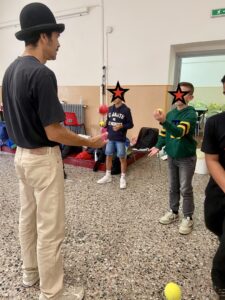
Workshop Scene
A red ball flies up into the air.
Time seems to stand still.
A little girl watches it rise, then follows it with her eyes as it falls.
Even her body follows the movement, as if searching for an invisible balance.
She opens her hand, trying to catch it again.
Sometimes she succeeds, sometimes she doesn’t.
But every time, something happens:
a gesture, a smile, a question.
Inside the classroom circle, voices emerge:
-“Why does it come back down?”
-“Why does it go faster when it’s near the ground?”
-“Why does it bounce?”
Physics is already there:
in the trajectory of a ball and in the eyes of those who observe it.

A Metaphor of Gravity
Every falling ball is a fragment of the universe revealing itself.
When we throw it, the rules seem to dissolve:
the ball rises, pauses, then falls back.
Yet that simple repeated gesture contains within it the laws of nature.
Here, learning is fully embodied:
there is no purely intellectual filter — we play.
In that short moment:
-
- Gravity is not an abstract concept,
-
- But an encounter between the body and the world.
The hand that throws and the hand that catches become instruments of measurement.
Physics is born in that ancient, simple gesture.
The observing body becomes a moving laboratory.
Didactic Perspective: From A-Didactic Situation to Formalization
This experience reflects the Theory of Didactical Situations by Guy Brousseau.
Learning begins with a lived, concrete situation — not explained, but experienced.
This is what Brousseau calls an a-didactic situation.
Key elements:
-
- Knowledge is not transmitted → it is constructed.
-
- Body, manipulation and emotion come before formal concepts.
-
- Sensory experience gives knowledge form, weight and meaning.
Only after this can abstraction become meaningful.
In this activity:
-
- The rising and falling ball → discovery of gravity.
-
- The ascent/descent times → intuition of motion symmetry.
-
- The bounce → a first hypothesis about elastic energy.
Only afterwards, with the students, can the formalization be introduced:
The law of conservation of energy: potential energy at the top, kinetic energy at the bottom.
The formula F = m · a, where the acceleration is that of gravity.
Parabolic curves, time measurements, height calculations.
Every experience offers many shapes of knowledge, all worthy of being explored and even more valuable when they arise from the curiosity of each individual student.
📚 Didactic references
Brousseau, Theory of Didactical Situations in Mathematics, Springer, 2002.
Galileo Galilei, Discourses and Mathematical Demonstrations Relating to Two New Sciences, 1638.
🔬 Scientific deepening – Formalization
Conservation of energy
The law of conservation of energy states that, in the absence of friction and resistance, the total energy of a system remains constant.
Total energy
Eₜₒₜ = Eₚ + Eₖ + Eₑₗ
where:
Eₚ = m · g · h (gravitational potential energy)
Eₖ = 1/2 · m · v² (kinetic energy)
Eₑₗ = 1/2 · k · x² (elastic energy, only during the bounce)
During the ascent and descent, without bouncing:
m · g · h + 1/2 · m · v² = Eₜₒₜ = constant
This implies:
At the top → v ≈ 0 → maximum potential energy – ball freezed. Kinetic energy zero
At the bottom → h = 0 → maximum kinetic energy – ball down Gravitational Energy zero
It is the classic potential ↔ kinetic exchange, intuitive in the act of throwing and perfect for sparking questions in students.
👉 And what shape does the energy of your lessons take? ✨
Share it in the comments or on my social channels!